
The First Step Costs Nothing: The Representative Office as a Foreign Bank’s Entry Vehicle
On 20 August 2026 the Federal Reserve approved an application by a foreign bank to establish a representative office in the United States. It is the kind of approval that draws no headlines, and that is precisely what makes it instructive. No capital was raised, no deposits were promised, no balance sheet was constructed. What the applicant obtained was something narrower and, in our experience, more valuable at the outset than any of those things: a named, supervised entity, standing on US soil.
We spend a good deal of our time correcting a single assumption. Senior bankers arrive at the first conversation believing that a US presence begins with capital, and that the only real question is how much. It is an understandable instinct, because every subsequent rung on the ladder does turn on capital and on the commitments that follow it. But the entry vehicle itself is not built that way. The representative office is defined in the negative, by the activities it may not conduct, and the figure attached to it is zero.
A Vehicle Defined by What It May Not Do
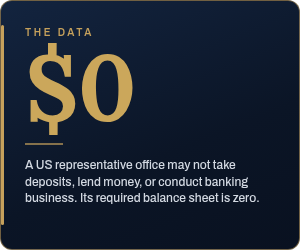
Under 12 CFR 211.24(d)(1)(i), the representational and administrative functions a representative office may perform “shall not include contracting for any deposit or deposit-like liability, lending money, or engaging in any other banking activity for the foreign bank.” That sentence is the whole architecture. There is no minimum capitalization to satisfy, no liquidity buffer to fund, no asset maintenance requirement to hold against US liabilities, because there are no US banking liabilities to hold anything against. The required balance sheet of a US representative office is zero.
We put this plainly to boards because the number changes the shape of the decision. A representative office is not a scaled-down branch. It is a different instrument, and the constraint that makes it cheap is the same constraint that makes it fast to justify internally. There is no credit committee argument to win and no capital allocation to defend against competing uses in the home market.
What the Office Is Permitted to Do
The permitted set is wider than the prohibition suggests, and it is the part most institutions underestimate. A representative office may solicit business for the parent bank, act as liaison between the parent and its US customers and correspondents, conduct market research, promote the bank’s name and products, and carry out administrative and back-office functions on the parent’s behalf. Loans may be marketed and negotiations advanced, provided the credit decision and the contract itself remain with the parent abroad.
For a mid-size commercial bank in Bogota, Panama City, Lima or Port of Spain, that permitted set covers most of what the institution actually needs in year one. It puts named officers in the same time zone as the correspondent banks that clear its dollars. It allows relationship coverage of US corporates trading into the home market. And it does all of this from an entity that is registered with, examined by and known to the Federal Reserve, which is a materially different posture from calling on the same counterparties from abroad.
Optionality Purchased Before Capital
The pattern is not confined to smaller entrants. Larger institutions use the representative office quietly and deliberately, as a way to buy optionality before committing capital to a market they have not yet tested. Caixa Bank’s New York representative office is a well-known example of the form, and we have supported institutions of very different sizes through the same vehicle for the same reason. It establishes presence, gathers intelligence and seasons a relationship with the US supervisory framework, all before the board is asked to approve a single dollar of dedicated capital.
We would add one caution. Zero required capital is not zero cost and not zero obligation. Premises, licensed officers, a compliance function proportionate to the activity, and disciplined observance of the activity boundary all cost money and attention. Institutions get into difficulty when a representative office drifts across the line in 211.24(d)(1)(i) because a well-meaning officer books something that should have been booked abroad. The boundary is the vehicle. Respecting it is the price of the standing it confers.
The first step onto US soil costs nothing on the balance sheet, and the institutions that use it well treat it as the first step rather than the only one. If your bank is weighing what a US presence should look like and where it should begin, come speak with Atlantis. We work alongside institutions as a partner from the first conversation through opening for business.