Candor Is a Licensing Condition
Candor is key in communication with your bank regulator. Whether one is making application for a de-novo banking charter or responding to a supervisor’s annual examination questions, forthright and complete answers are mandatory.
When applying for approval to establish a regulated banking entity in the US, a description of the applicant’s proposed business strategy, including all products that entity will offer, is required. Often, to shorten the application list of responses required or for ‘expediency’ the applicant is tempted to exclude lines of business, hoping that they can be added later, post preliminary approval. For example, apply for a branch that focuses on corporate clients and later add a personal wealth management business. Not a good idea. Regulators loath last minute additions or changes to a proposed business strategy. Even worse, regulators abhor communications that are abstemious with the truth.
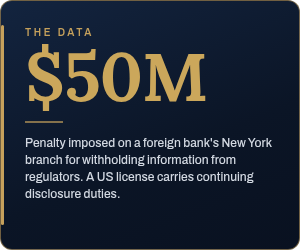
In July 2026, the New York State banking regulator entered a consent order fining Swedbank AB and its New York branch 50 million dollars. The finding was not for loan losses, insufficient capital or a missed regulatory filing. It was about candor. The regulator concluded that Swedbank AB and its New York branch failed several times to provide complete information to New York regulators regarding its Baltic subsidiaries’ connections to Mossack Fonseca, a firm found assisting clients to evade sanctions and taxes (the “Panama Papers”).
For any foreign bank that operates a US branch, or that intends to, the order is worth reading carefully. It is a statement explaining the level of transparency a US licensee/charter holder is obliged to provide to their regulator.
The data
A US branch is not a marketing outpost. It is a supervised entity, and that entity is required to provide information. When a regulator asks a question, the regulator expects a fulsome response, with no obfuscation. The regulator found that Swedbank-New York Branch deliberately submitted a partial answer and determined it was not Swedbank’s prerogative to decide what to answer. The 50 million dollar penalty was imposed due to the failure to be fully responsive.
Home-market practice does not always prepare you
Banks are shaped by the supervisory culture of their home jurisdiction. A response that is customary in one jurisdiction, where scope may be narrow and disclosure minimal, is very different from one a US examiner demands, where the expectation is that the bank surfaces relevant facts without the examiner having to ask precisely the right question. That gap in expectation is where trouble begins.
This is not a reason to avoid a US presence. It is a reason to enter fully prepared and with clear intentions. Institutions that operate US branches well are those that internalize the supervisory standard early and build their compliance and disclosure practices to meet it, rather than discovering the standard through an enforcement action.
Atlantis advises foreign banks and fintechs in many ways, by guiding submission of comprehensive bank applications, building US compliance and disclosure practices that meet the supervisory standard from the start and leading regulatory remediation when a relationship needs repair.
In context
A US license is valuable, and it carries continuing obligations where non-compliance may be fined millions of dollars. The transparency a US regulator expects is not a trap. It is the price of having a supervised entity, and is entirely manageable for an institution that plans and complies.
If you operate a US branch or are preparing to apply for one, we welcome a conversation about meeting the supervisory standards with confidence.